OOWNEYA LIFE IN TAGSTHE POSTAL DOG
1888 — 1897

A DOG. THE MAIL. AN UNLIKELY ADVENTURE.

Meet Owney.
He followed
the mail.

In 1888, a scruffy dog found a home at Albany’s post office. He rode the mail trains, collecting friends—and the tags they gave him—along the way.

Scroll to discover his story

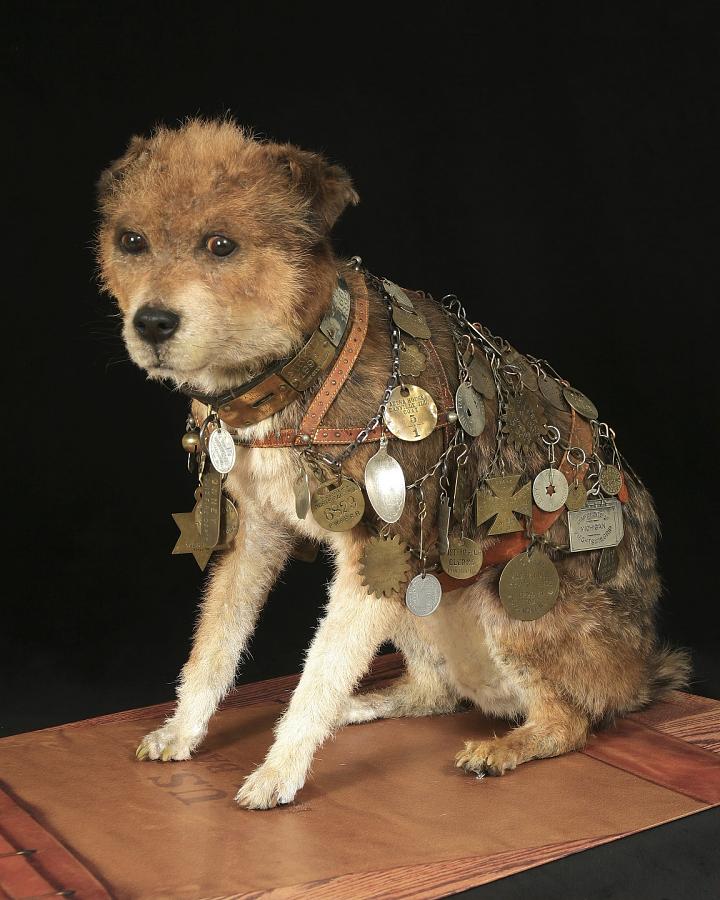
Owney, the small brown postal dog, preserved wearing a harness covered in travel tags
Owney and his travel tags
Preserved specimen · Smithsonian National Postal Museum
FROM RAILWAY STOPS TO SMALL KEEPSAKESTHE JOURNEY · THE COLLECTION · YOUR TAG
A little dog, a life full of journeys.
More than a century ago, this was his world.

Owney’s journey.

AI-generated background image

Choose a shape, theme, or material first to reveal its available connections and counts. Counts follow your selection order, within the selected year or story scope and before date highlighting. Click a selected icon again to clear just that filter. Hover or focus Shape to reveal the Theme expand button, then Theme to reveal the Material expand button. Hover or focus a plus to preview its first icon; click to expand the choices. The × in a column or its breadcrumb clears that filter and folds the column. The minus or Escape only folds it, keeping an active filter visible in the breadcrumb. On touch screens, tap to expand Theme, then Material.

Hover to preview · Drag to rotateTap a tag to explore

Confirmed placesSelected dates
CANADAUNITED STATES

SOME STORIES HAVE GAPS

Leave room for the unknown.

A broad date is a span, and an associated town is not always a visit. Broadly dated objects stay in the collection. Tags with a precise date but an unresolved location can appear in the cube without a map point.

KEEP EXPLORING / 02

02 / WHAT PEOPLE GAVE HIM

Small objects. Many stories.

377 tags, each with a story to discover.
Choose an object to read its museum record.

All 377 tag records from the 22 September 2026 search snapshot are included. Shapes are visually reviewed groupings of the main object outline, not museum catalog fields. Browsing themes are editorial groupings; “Other connections” includes objects without a specific theme assignment. Dates and places retain the museum’s wording. These are museum photographs with backgrounds removed and display size normalized. Select a tag to see its unedited museum photograph. Collar-mounted tag details are labeled.

KEEP EXPLORING / 03
Small reminders of a life well traveled.

03 / A NEW GENERATION OF FRIENDS

His journey continues.
Leave a little of yours.

Once, admirers gave Owney tags to remember them.
What would yours say?

A place. A few words. A new connection.
Add a digital tag to this shared collection of Owney’s friends.

0 / 180

Your place and message will be visible to everyone. Keep it kind, and leave out contact details.

From today’s travelers

VISITOR-CREATED TAGS · A CONTEMPORARY TRIBUTE

Opening the collection…

These messages belong to this visitor collection. They are not historical objects or part of the Smithsonian’s collection.

ABOUT THIS EXPLORATION

Evidence, with space for imagination.

Owney became a fixture at the Albany post office in 1888 and traveled with the mail until 1897. Postal workers and admirers gave him tokens of their connection. This exploration includes 67 tags with precise recorded dates from 1892 to 1897. The original fourteen story highlights remain available as a smaller selection.

The objects

All 377 tag records are included from a Smithsonian Open Access snapshot retrieved 22 September 2026 (UTC). A search for “Owney” returned 422 distinct records; 377 were National Postal Museum records with “Owney” and “tag” in the title. All 742 image entries in that tag subset were marked CC0. Counts describe this search snapshot, not all objects that ever existed.

The scenes

Fourteen images were made with OpenAI’s built-in image-generation tool, using a Smithsonian photograph of Owney as an appearance reference. The fourteen highlighted stories use scenes informed by the linked records. Additional tags share an imaginative railway backdrop; it does not depict their specific place or exchange. Buildings, people, gestures, lighting, and composition are interpretations. These images are not historical photographs. A cropped view is used where needed to exclude an anachronistic generated background.

The animated Owney between chapters is a new illustration inspired by his preserved appearance. It imagines him in motion; it is not historical footage.

Reading the map and cube

The map includes only tags whose museum descriptions explicitly place Owney’s visit or the exchange in a single named city. Donor hometowns, workplace addresses, manufacturers, advertising places, railway services, multiple locations, and conflicting records are omitted. All dated tags stay in the cube. Each decision is explained under “What the record supports.” The displayed dates remain recorded tag dates; they are not independently verified arrival dates. Markers use approximate city centers added for this prototype; the API provides no coordinates. The cube holds museum tag photographs. The objects are centered on transparent layers, with their photographic backgrounds removed. The original object pixels are preserved; unedited photographs remain available in each museum record dialog. The collection uses centered transparent cutouts; a few collar-mounted objects are shown as labeled tag details. Depth orders the associated encounters. The AI illustrations appear only in the section background. Even spacing is a browsing aid. Calendar spacing preserves relative date gaps, including periods without selected evidence. Switching to Timeline view chooses calendar spacing; switching to Cube view chooses even spacing. The spacing menu can override either default. Cube view shows the transparent photographs. Both view buttons smoothly rotate the same cube. Dragging near the edge-on angle gently aligns it with Timeline view. Timeline view looks across the thin layers with the Z (time) axis running horizontally; calendar spacing reveals clusters and gaps among the displayed dated tags, not the rate at which all 377 objects were collected. One layer represents one object. There are 61 exact-day catalog fields and six additional precise dates in museum descriptions (tags 19, 122, 153, 183, 205, and 457). Broad dates, manufacture years, and speculative gift dates are excluded. Conflicting precise dates remain visible with an evidence warning. Tags sharing a date occupy the same time position. The timeline below the cube plots the number of objects on each recorded day. Drag across it or adjust its two date handles to highlight a period in the cube and map. Highlights and the selected encounter update while you drag. Empty periods clear the map highlight. Other tags and confirmed places remain faintly visible for context. Previous and Next beside the story reach each object in the highlighted range, including objects sharing a date. Hover previews any visible tag without changing the highlighted dates. Clicking a tag, choosing its map point, or opening it from the collection shifts the date window to include it while preserving its duration. The initial range highlights 1892; All dates highlights the full displayed selection. The year, story, shape, theme, and material filters affect both map and cube. The three icon rails intersect these object characteristics. Start with any rail: its selection reveals available connections in the others. Counts follow the order in which you select the filters. The first count is before the other filters; later counts are cumulative intersections within the year or story selection, before date highlighting. Click a selected icon again to clear only that filter. Changing an icon preserves the other filters; clearing one promotes the remaining selections. Theme and Material start folded. Hover or focus either labeled plus to reveal only its first icon, then click the icon or plus to expand its choices. The × in a column or its breadcrumb clears that filter and folds its column. The minus or Escape only folds the column, keeping an active filter named in the breadcrumb. Reset clears all three. On mobile, tap to expand; each rail becomes a horizontally scrollable row with large touch targets. Materials come from the museum’s recorded medium field. Brass, copper, silver, leather, and metal with enamel are grouped separately; records that say only “metal” remain “Metal, unspecified.” Technique suffixes such as engraved or plated do not form separate groups. The unedited material wording appears under “What the record supports” and in the museum record. Lines show combinations of object characteristics, not travel routes. These counts cover dated journey tags before the date brush; the highlighted count below the cube follows the brush. Collection theme groupings are editorial, not museum classifications. Shapes are manually reviewed visual groupings of the main tag outline, rather than museum catalog fields. Small hanging rings and internal holes do not define the shape. Selecting a shape highlights its full matching date span and preserves date order; the date brush can narrow it. A combination with no matching tags shows an empty view. The uniform layer thickness is a visual aid, not measured object thickness or a duration. Closely dated layers can overlap; Previous, Next, and the cube arrow keys reach each one. No inferred travel routes are drawn. For the Tacoma/Puyallup chapter, the tag date (14 August) and departure date (19 August) are distinct. A missing or unresolved location receives no map point. The dates for the Cheyenne and San Francisco tags conflict, as do the simultaneous Pierre and Lawrence dates; these records are not connected by a claimed route. Brooklyn’s April 12 tag and the April 9 newspaper report describe different evidence. Scotland’s March 17, 1897 gift date is distinct from the token’s older 1883 marking; its donor’s town does not prove the exact place of exchange.

Museum background and token themes ↗
Smithsonian API documentation ↗
Map data: Natural Earth, via World Atlas ↗
Time-volume inspiration: Bradley Tangonan’s “xy + t” ↗